On World Mental Health Day, , GAZHP Health and The YANA Foundation announced the winners of the 2026 Nationwide University Mental Health Essay Competition. Students from universities and higher education institutions across Zambia wrote on the theme "Prioritising Student Wellbeing, Breaking Stigma and Navigating Mental Health Pressures in Zambian Higher Education", and three essays stood out.
The 2026 winners
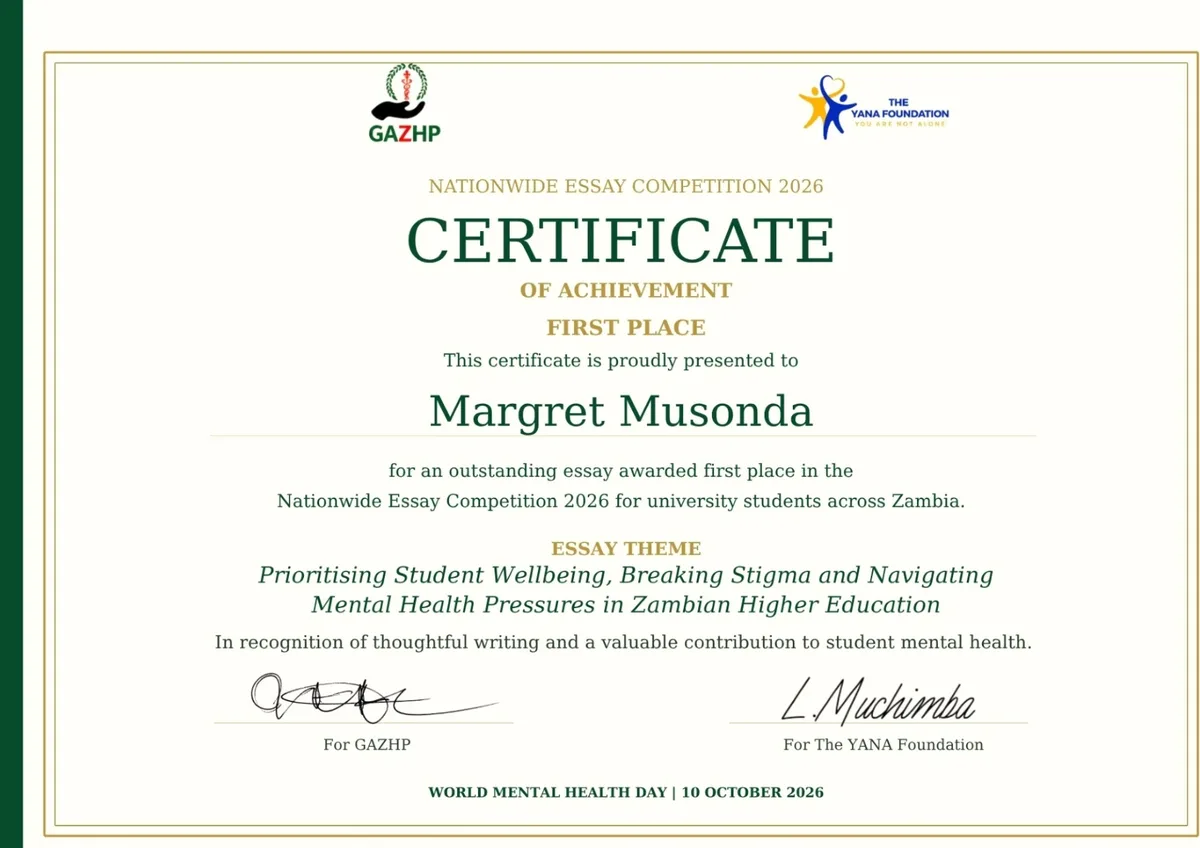
- First place: Margret Katebe Musonda — To Be Okay, To Truly Be Okay: The Zambian Student
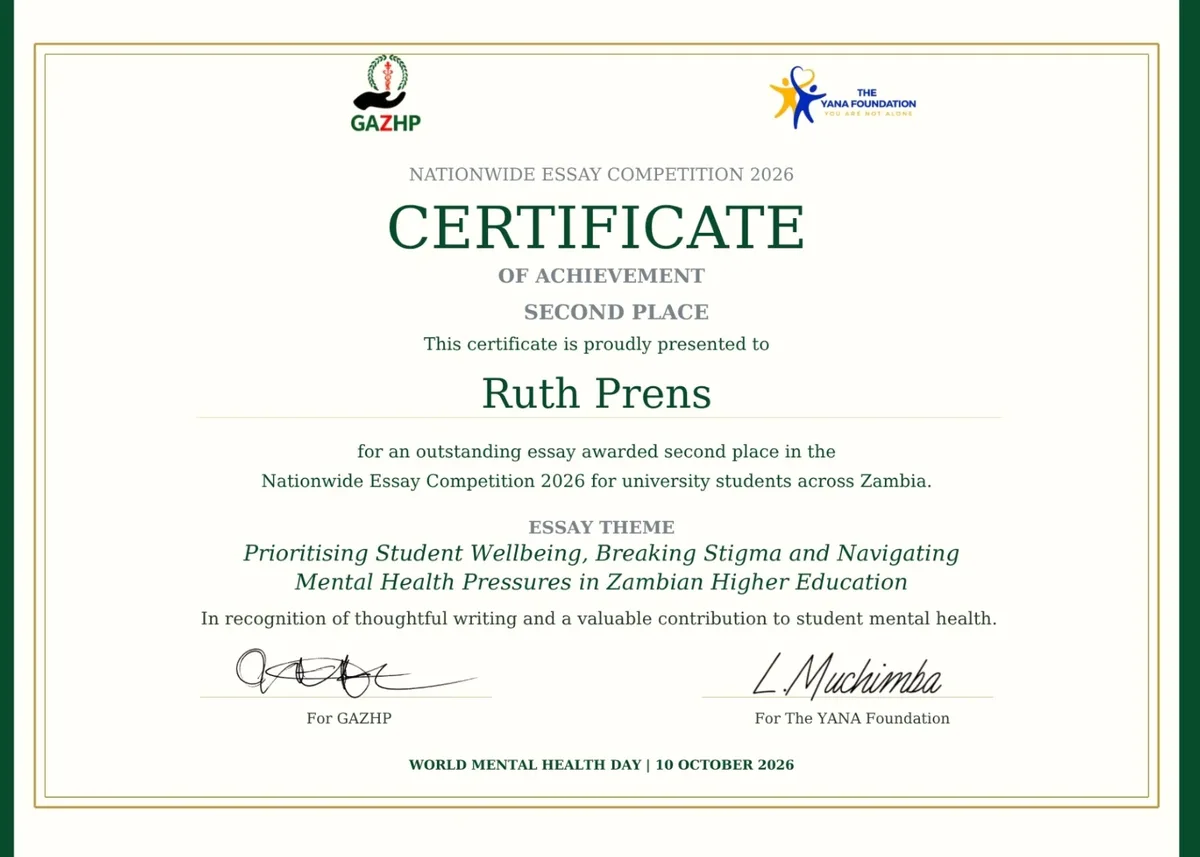
- Second place: Ruth Prens — You Chose This
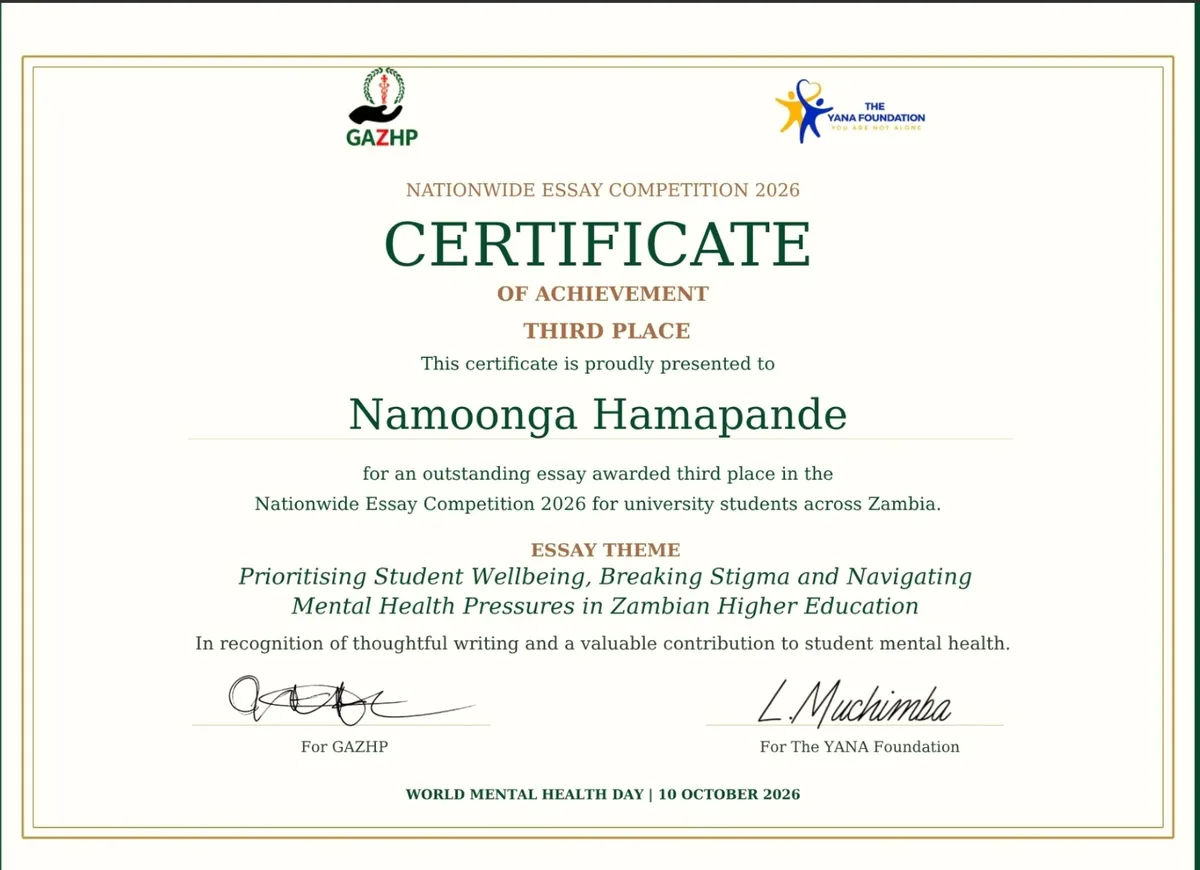
- Third place: Namoonga Hamapande — Beyond the Transcript
Congratulations to all three. Each winner receives a co-branded Certificate of Achievement, a cash prize (US$100, US$75 and US$50 for first, second and third place) and mentorship through the combined professional networks of GAZHP Health and The YANA Foundation. Every eligible participant receives a digital Certificate of Participation.
What unites the three essays is honesty. All three writers are medical students, and each draws on their own experience of pressure at university — sleepless nights, falling behind, the quiet competition over who is most exhausted — before turning to what universities, lecturers, families and faith communities can do differently. Thank you to everyone who entered, and to The YANA Foundation for partnering with us again this year. The full text of each winning essay is below.
First place — Margret Katebe Musonda
To Be Okay, To Truly Be Okay: The Zambian Student · Fifth-year medical student
Read the essay: To Be Okay, To Truly Be Okay: The Zambian Student
Being admitted to university is such an exciting milestone, for me it was the first time I was going to be away from home. I had never been in a romantic relationship hence I was looking forward to that too. It filled me with a sense of pride and represented independence and growth. But I was not prepared for the pressures that come with being a student as are many others, the increased workload, navigating failure, the feelings of not belonging, financial pressure, the burden of expectations, relationships and so many others. It is in University that I have had the most difficult mental and emotional breakdowns, the crushing thoughts of not being enough.
Zambian higher education must shift from surviving academic stress to actively safeguarding student well-being, a transformation that must begin long before a student ever steps foot onto a university campus. Mental health should be incorporated into primary and secondary schools. By embedding emotional intelligence, stress management and open discussions about mental health into primary and secondary school curriculums, we break a cycle of silent endurance early, ensuring students enter university already equipped to recognize when they are not okay and seek help without shame. This will help normalize and teach kids at a young age that the same way you take care of your physical health for example brushing your teeth every morning, bathing every day to feel fresh, is the same way your mind also needs care. The World Health Organisation (WHO) defines health as a 'state of complete physical, mental and social well-being and not merely the absence of disease and infirmity'. Everyone deserves to know this and what it entails.
When a semester or year starts, new students are orientated in different Zambian Universities, at the University of Zambia for example this takes a week before classes start. Orientation should not just map out physical surroundings, it must map out emotional and psychological support systems. Introducing mental health resources during welcome week embeds wellness into the Universities core culture, normalizing support before academic pressures start. This can include dedicated sessions on how to manage stress, time management, recognizing depression and burnout in yourself and others, mental health first aid kits or guides in forms of small books or digital guides detailing self-care strategies, school campus counsellors and step by step instructions on how to get help. Peer mentor connections can also be included in this, where incoming students are paired with senior students who can act as informal check-ins for students. Students who genuinely care about the wellness of other students should be trained and help champion mental health discussions on campuses.
Stigma remains an important barrier to mental health help seeking among University students, as students who perceived greater stigma were less likely to seek professional help (Milanzi et al., 2023). This reluctance to seek help is heavily driven by fear of being judged by peers and internalized self-stigma. Institutions must complement physical counselling centres with digital counselling portals that would be available 24/7 for students paralyzed by the fear of judgement or public identification. Virtual platforms will provide a low stigma space to offload their burdens. Students can be given options of counsellors to talk to, choose the time and choose whether they want their identities revealed or remain anonymous, they can also choose between virtual or text based counselling. This will allow students to get help from the privacy of their hostel rooms, boarding houses or home.
Lecturers play a critical role in student's mental well-being because they maintain consistent contact with students, they are uniquely positioned to spot early indicators of psychological distress. Hence lecturers should also be educated on what mental health is, the things that affect student's mental well-being and tools that can help. By normalizing wellness resources in lectures and lecture notes and serving as empathetic bridges between students and physical and digital counselling platforms, lecturers can dismantle the fear that keeps so many students from seeking help.
Undergraduates in higher education represent Zambia's future human capital, its upcoming doctors, engineers, policy makers, teachers and innovators. When students fail, drop out or graduate while carrying emotional and psychological burdens, the nation loses vital productivity. Investing in student mental health is an investment the government should make because it impacts its national stability and economical growth.
Mental health is an individual and personal matter, the condition of an individual human mind (Jahoda, M. 1958, Current concepts of positive mental health). Before the institutions can help us, we as students need to take responsibility for our own mental health and be intentional about it. Only we can tell how we feel, when something is wrong with us and can only be helped if we open up and talk to someone. This can include small steps such as having enough sleep, having goals you are passionate about, being kind to yourself, planning your days and studying early and not waiting for work to pile up and being content with what we have at the moment while working towards something better. We need to be intentional about having meaningful and intimate relationships. I always found that when I am having a bad day calling and talking to my Mom, Dad or siblings always makes a huge difference. I also discovered that having things that I enjoy outside of school makes me happier. I enjoy reading books, crocheting and listening to podcasts and so I make time for these things over the weekend. We need to incorporate compassion and altruistic behaviour into our daily lives, be mindful of the things we feed our minds and believe about ourselves. Cultivating compassion and empathy for others and ourselves will help us gain a sense of purpose and live more fulfilling lives.
Second place — Ruth Prens
You Chose This · Medical student
Read the essay: You Chose This
Monday – 4:17 a.m.
My eyelids are getting really heavy. I should be asleep. Instead, I have been staring at the same lecture slide and I can't seem to grasp anything. A good eight hours of sleep would be nice, but I am a medical student, why would I sleep for more than six? Pressure and exhaustion mean I am working; they mean I am committed. I am willing to do and sacrifice all I can to be an excellent doctor.
Wednesday – 9:42 p.m.
Today, I complained that I was tired.
"You chose this," my friend said to me.
She was right. Nobody held a gun to my head when I chose this course. "How will you manage when you start working?" she asked. I stopped complaining. I have to be resilient. I have to push through, even when its overwhelming. Could the fact that I am admitting that the pressure is too much mean that I am not strong enough for this career?
Friday – 10:36 p.m.
I was on a call with Miriam tonight. She was telling me she was overwhelmed, but what does she know? She is studying education. She doesn't know what real pressure is. What irritated me even more, was that she recommended I sleep more. She doesn't have my lectures or examinations. She simply doesn't get it. I did not notice the irony then.
Sunday – 1:18 a.m.
"I got four hours." "Lucky. I only got two." "Well, I didn't sleep at all." We laugh as we compare our determination. There is a strange competition among students, now exhaustion sounds impressive. I guess the line between discipline and self-neglect is not so clear anymore.
Tuesday – 8:05 p.m.
I have been in such a bad mood today, I can't even recall anything I read. It's been long since I called home and I have been ignoring my friend's messages. I will attend to them after my exams, I have to focus on my studies. Even resting makes me feel guilty. I am beginning to wonder whether being constantly overwhelmed was normal, or it had just become common. Am I coping? Or had I simply learned to suppress my feelings and functioning while exhausted?
Thursday – 11:14 p.m.
The question stayed on my mind. When I started to explore beyond my own experience, I discovered that mental health is more that the absence of a diagnosed illness. It is also connected to wellbeing and the ability to cope with life's stresses (World Health Organization, 2022). That unsettled me, I have been functioning. I attend all my lectures and submitted assignments, but I realized functioning doesn't necessarily mean I am well.
Research among university students in Zambia has identified barriers to seeking mental-health support, including stigma (Milanzi et al., 2023). The study involved students at Mulungushi University and found that many students were not willing to seek help for their problems. The silence is not evidence that we as students are fine, but simply that we learned to struggle quietly.
Saturday – 4:27 p.m.
Philemon was complaining today about how hard engineering is and that we medical student have it easy. It honestly irritated me. In that moment, I thought of Miriam and how I dismissed her struggles. I did to her exactly what I hated being done to me. Her struggle didn't matter less because I considered my degree more difficult. We have really turned suffering into a hierarchy. It's not only stigma when its surrounding mental illness such as depression, it's also stigma when the environment makes student feel they must prove that their distress is serious enough to deserve concern. Fear of judgement and stigma have become a barrier between struggling and seeking for support.
The problem is not only that we are struggling, we are too busy comparing our suffering to recognize it in one another.
Monday – 7:53 p.m.
The more I paid attention, the more I realized that pressure looked different for everyone. One student is worried about deadlines and another is worried about what they are going to eat tonight. Our degrees were different and so were our problems. We all hear the same thing. "Cope, do not complain. You chose this." Perhaps student wellbeing in Zambian higher education requires us to stop measuring someone's struggle against another person's.
Wednesday – 9:11 p.m.
If we have learned to normalize exhaustion, maybe we can normalize asking for help.
Prioritizing student wellbeing requires more than telling students to practice self-care, while leaving the culture around them unchanged. Universities need visible, accessible and confidential support systems. Support should be available before a student reaches crisis point. However, institutions cannot solve this problem alone. Lecturers, student leaders and students also shape whether it feels safe to say, "I am struggling". Education on signs of early distress can help, before the victim even realizes it.
A difficult degree should still be difficult, academic standards should remain high. But we shouldn't carry chronic exhaustion and self-neglect like badges of honour. Hard work is necessary, but suffering silently should not be.
Friday – 4:17 a.m.
My lecture notes are waiting and medicine is still hard. When someone says, "You chose this," they aren't wrong. I did choose medicine, I chose the responsibility, discipline and difficult years. Choosing this, doesn't mean I chose exhaustion or to believe that silently losing myself makes me stronger. I now believe that real resilience is having the courage to say that something needs to change.
This time, I actually closed my laptop. I'm going rest and this time without a guilty bone in my body.
References
Milanzi, J., Makukula, M. K., Lyambai, K., Kabungo, C. J., Matipa, R., & Changwe, G. (2023). Barriers to mental health seeking intentions among students at Mulungushi University, Kabwe District, Zambia. European Journal of Public Health Studies, 6(1). https://doi.org/10.46827/ejphs.v6i1.140 (opens in a new tab)
World Health Organization. (2022). Mental health: Strengthening our response. World Health Organization.
Third place — Namoonga Hamapande
Beyond the Transcript: Prioritising Student Well-being, Breaking Stigma and Navigating Mental Health Pressures in Zambian Higher Education · Fifth-year medical student
Read the essay: Beyond the Transcript
There is a unique kind of loneliness that comes with falling behind at university. It is not always loud. It is not always cruel. Sometimes, it is simply the silence; when classmates move on and the shared timetables disappear.
As a fifth-year medical student, I know this feeling. I have gone on part-time more than once. Each academic setback hit harder than my transcript. It tested my confidence, my relationships and my sense of belonging. Friends moved forward while I remained behind. None intentionally excluded me, but the common ground we once shared slowly faded away. It is difficult watching people you started with continue the journey while you are forced to find your own way through a timeline you never planned for.
Mental health challenges in higher education are often discussed as though they exist separately from academics. In reality, academic pressure, financial stress, family expectations and personal ambition are tightly woven together. For many students, there is also the added weight of simply affording to stay in school. Sometimes, the fear is not only, "Will I pass?" but also, "What happens if I cannot afford to continue?"
When people do not know how to respond, stigma can look like uncertainty more than discrimination. Friends do not always know what to say. Parents and guardians may be heartbroken but unsure how to help. Sometimes it sounds like, "You will get over this," or, "You are not the first person to go through this." Perhaps these words are not intended to hurt, but when someone is already struggling, they can make them feel as though their pain is an inconvenience or a sign that they simply are not trying hard enough.
Slowly, a student begins to believe that they are alone and that they simply need to toughen up.
For some male students, this can be even more difficult to navigate because of societal expectations that associate strength with silence. The pressure to appear strong can make asking for help feel like admitting weakness, when in reality, knowing when to ask for help is itself a form of strength.
In a country where faith is an important part of many people's lives, I also believe we need to talk honestly about the role of religious communities. For many students, the church is one of the first places they would naturally run to before a crisis. It should be a place of safety, understanding and restoration. Yet for some, it becomes the place that feels hardest to return to after failure.
If you were raised in a strict religious home, you may understand this. Sometimes, church hurt after failure kills a part of you that becomes difficult to revisit. This is not about placing responsibility for mental health on the church. Rather, it is recognising that religious communities are already deeply woven into the lives of many young people and therefore have an opportunity to become part of the solution. Church leaders and youth programmes can be equipped to recognise distress, respond without judgement and know when to encourage professional support.
Along the way, we also lose classmates and friends to death. While still young and navigating the many demands of tertiary education, grief can suddenly become part of the journey. The people who once pushed us, supported us and believed in us are no longer there to finish the race with us. Emotionally and psychologically, you begin to use twice as much energy trying to show up for yourself and for the people who believed in you when things were rough. Yet there are often few spaces where students can openly grieve while still being expected to attend lectures, write examinations and keep moving.
Meanwhile, policies may exist, but policies alone cannot hold a struggling student.
What can help is proactive outreach: connecting students with counselling before they reach crisis point, training lecturers and academic staff to recognise signs of distress, and creating peer-support groups where students with shared experiences can talk, help, support and actually feel understood. Universities could also establish clear referral pathways so that when a lecturer, friend or family member notices that something is wrong, they know where to turn.
Secondly, families need to be included. Parents and guardians can be given guidance on how to respond when results come out, when disappointment or worry reaches home, and when a student needs support rather than additional pressure. Universities can also strengthen financial literacy and student financial-support programmes because financial stress does not stop at the classroom door; it follows students into their mental and emotional lives.
Our communities must be part of this conversation too. Churches, youth organisations and other community spaces can create conversations around mental health, failure, grief and the different timelines of young people. This may not be easy to implement, but I believe change starts with one step, one conversation and perhaps, one person willing to understand differently.
Ultimately, higher education should aim to produce capable, resilient graduates, not just impressive transcripts. A delayed graduation should not become a delayed life. Failure should not become a sentence of isolation. And no student should have to suffer in silence simply to earn a degree.
What happens next
The winning essays will also be shared across GAZHP Health's international platforms and The YANA Foundation's national media channels. The essays are published here with the authors' names as they appear on their certificates; the views expressed are the authors' own.
GAZHP runs initiatives like this to amplify young Zambian voices and build a culture of openness and support around mental health — read more about our Addiction & Mental Health program, the 2026 competition and the 2025 Youth Mental Health Essay Competition.
Want to support initiatives like this? Donate to GAZHP or become a member.